W-2 versus 1099: the real take-home difference
Offered the same $60,000 as an employee or as a contractor, the contractor keeps less. Not because the tax rate is higher, but because the employer's half of Social Security and Medicare becomes the contractor's problem, and so does everything else the employer used to handle.
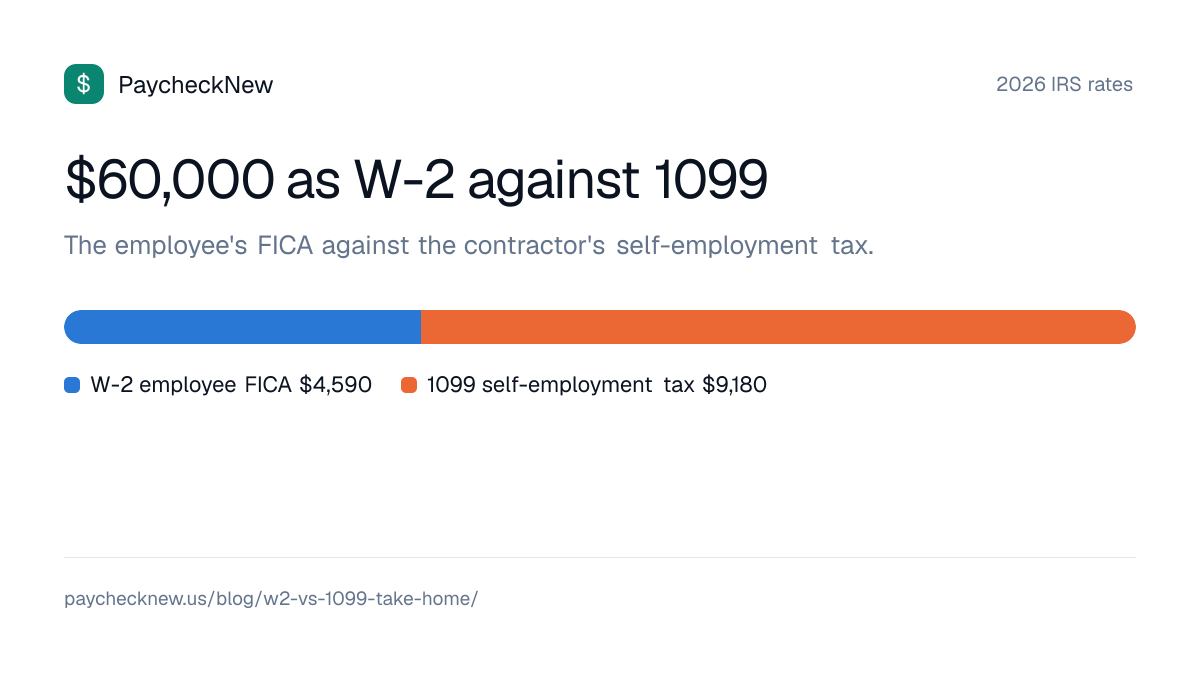
Self-employment tax is the whole difference
An employee pays 7.65% for Social Security and Medicare and the employer matches it. A contractor pays both halves, 15.3%, as self-employment tax. On $60,000 that is $9,180 against the employee's $4,590. Half of it is deductible against income tax, which softens it, but the cash still leaves.
Nothing is withheld
A 1099 has no withholding at all. The contractor sets money aside and pays estimated tax four times a year, in April, June, September and January. Miss a quarter and the IRS charges interest. This is the single biggest surprise for people moving from a W-2 job: the whole tax bill is on you to hold and send.
What else the employee gets
Half of FICA is the visible cost. The invisible ones are unemployment insurance, workers' compensation, any health plan contribution, paid leave, and the 401(k) match. None of those exist on a 1099 unless the contractor buys them.
The rate a contractor should ask for
A common rule is 25% to 30% above the equivalent salary, and the arithmetic supports it. The extra 7.65% FICA alone is $4,590 on $60,000; add health cover and unpaid time off and the gap is real. A contractor quoting the same number as the employee's salary is taking a pay cut.
Run your own numbers
Every figure above came from the paycheck calculator with 2026 rates.
Frequently asked questions
Is the tax rate higher on 1099 income?
Income tax is the same. The difference is self-employment tax, 15.3% instead of the employee's 7.65%, because there is no employer paying the other half. Half of the self-employment tax is deductible when working out income tax.
Can a contractor deduct expenses an employee cannot?
Yes. Business expenses reduce a contractor's net profit before self-employment tax and income tax are calculated: equipment, software, a home office, mileage. Employees lost the deduction for unreimbursed job expenses in 2018.
Does this calculator work for 1099 income?
It models W-2 employment. For contractor income, treat its FICA line as roughly half of what you will owe, and remember nothing is withheld. A quarterly estimated-tax calculation is a different tool.
Read next
- Salary versus hourly: which actually pays moreA $30-an-hour job and a $62,400 salary are the same gross on paper.
- How to read a US pay stub, line by lineWhat each line on a pay stub means, in the order payroll applies it, with a $60,000 example showing how gross becomes net in 2026.
- Form W-4 explained: how it decides your withholdingWhat each step of the W-4 does to your paycheck, why the form has no allowances any more, and how to set it so you neither owe nor over-withhold.
- Every paycheck deduction, in orderThe parent page for all of these.
Hadi · Developer and maintainer
Federal tables checked against the IRS 2026 inflation adjustments on . State figures, where quoted, are each state's latest published schedule, 2025; federal figures are 2026.