$35 an hour is how much a year?
At 40 hours a week for 52 weeks (2,080 hours), $35 an hour is $72,800 a year before tax. That is $6,067 a month, $2,800 every two weeks and $1,400 a week. After 2026 federal income tax and FICA, a single filer in a state with no income tax takes home about $60,045 ($2,309 per bi-weekly check).
Take-home pay per paycheck (26/yr)
$2,309.42
$60,045 a year from $72,800 gross, in Texas.
Take-home pay $2,309.42 per paycheck (26/yr), $60,045 a year, in Texas.
- Take-home pay 82%
- Federal income tax 10%
- Social Security (6.2%) 6%
- Medicare (1.45%) 1%
Which federal brackets your income fills
2026, singleOnly the part of your income inside each band is taxed at that band's rate. Your taxable income of $56,700 fills the bands below; the darker one is where your last dollar lands, which is your 22% marginal rate.
Breakdown
Texas, 2026| Item | Per paycheck | Per Year | % of gross |
|---|---|---|---|
| Gross pay | $2,800.00 | $72,800 | 100.0% |
| − Federal income tax9.9% | $276.38 | $7,186 | 9.9% |
| − Social Security (6.2%)6.2% | $173.60 | $4,514 | 6.2% |
| − Medicare (1.45%)1.5% | $40.60 | $1,056 | 1.5% |
| − Texas income tax0.0% | $0.00 | $0 | 0.0% |
| Take-home pay | $2,309.42 | $60,045 | 82.5% |
Assumes 40 hours a week for 52 weeks (2,080 hours; a standard full-time year is 2,080).
Your tax rates
- Effective rate 17.5%
- The share of your whole $72,800 that goes to tax. This is the one to quote when comparing offers.
- Marginal rate 22% federal
- What the next dollar you earn is taxed at. Always higher than the effective rate, and it is why a raise never leaves you worse off.
Estimate of annual tax liability spread evenly across pay periods, using 2026 federal rates, the standard deduction and no Texas income tax. Actual withholding depends on your W-4 and is squared up on your return.
- Per year, before tax
- $72,800
- Per month, before tax
- $6,067
- Bi-weekly, before tax
- $2,800
- Per week, before tax
- $1,400
$35/hour after taxes by state (2026, single)
| State | Total tax | Net per year | Net per hour | Effective rate |
|---|---|---|---|---|
| Texas | $12,755 | $60,045 | $28.87 | 17.5% |
| California | $16,380 | $56,420 | $27.12 | 22.5% |
| New Jersey | $15,918 | $56,882 | $27.35 | 21.9% |
| Indiana | $14,909 | $57,891 | $27.83 | 20.5% |
| Michigan | $15,603 | $57,197 | $27.50 | 21.4% |
| Maryland | $15,850 | $56,950 | $27.38 | 21.8% |
| Wisconsin | $15,289 | $57,511 | $27.65 | 21.0% |
| Missouri | $15,261 | $57,539 | $27.66 | 21.0% |
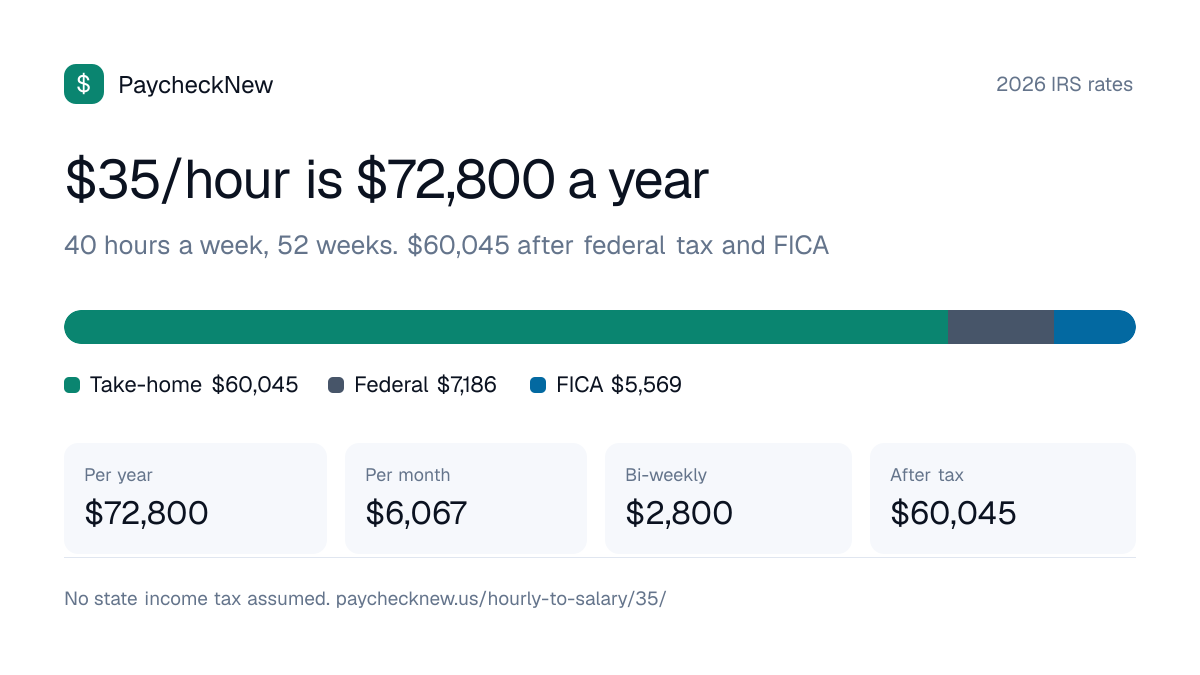
How the $72,800 figure is worked out
Full-time in the US is usually counted as 40 hours × 52 weeks = 2,080 paid hours, which includes paid vacation and holidays. If you are not paid for time off, use 2,000 hours (50 weeks): $35/hour then comes to $70,000. Part-time at 30 hours a week is $54,600. Overtime at 1.5× pays $52.50 an hour.
The after-tax figure subtracts 2026 federal income tax (10% to 37% after the $16,100 standard deduction), and 6.2% Social Security plus 1.45% Medicare, together FICA. State tax ranges from nothing in Texas or Florida to several thousand dollars in California or New York, which is why the table above varies by $3,625.
How to use this calculator
- Step 1
Split the deductions
On $72,800, $7,186 goes to federal income tax and $5,569 to Social Security and Medicare. Your W-4 moves the first; nothing moves the second except a section 125 plan.
- Step 2
Compare it with a salaried offer
$35 an hour is worth about $72,800 a year, so weigh it against $73,000 a year rather than against another hourly rate. Salaried roles usually include paid leave, which the 2,080-hour figure already assumes you get.
- Step 3
Work out what a raise is worth
A dollar more an hour is $2,080 a year gross at full time, but only about $1,463 after federal tax and FICA. Ask for the rate, then check the net.
- Step 4
Add overtime if you work it
Time and a half on $35 is $52.50 an hour, so five overtime hours a week is $13,650 a year on top, taking the gross to $86,450.
Only $6,300 of this salary is taxed at 22%
Being "in the 22% bracket" describes the last dollar, not the salary. Taxable income is $56,700 after the $16,100 standard deduction, of which $6,300 falls in the 22% band and everything beneath it is charged at the lower rates. That is why federal tax totals $7,186 here, an effective 9.9% rather than 22%.
Frequently asked questions
What is $35 an hour annually?
$35 an hour is $72,800 annually at 40 hours a week for 52 weeks (2,080 hours). If you work 37.5 hours a week it is $68,250, and at 35 hours a week $63,700.
If I make $35 an hour, how much is that a year after taxes?
About $60,045 a year for a single filer in a state with no income tax, once $7,186 of federal income tax and $5,569 of Social Security and Medicare come out. That is $2,309 per bi-weekly paycheck and an effective tax rate of 17.5%.
How much is $35 an hour per week and per month?
$1,400 a week before tax, $2,800 every two weeks and $6,067 a month. Take-home is roughly $5,004 a month in a no-tax state.
How much is $72,800 after tax in California?
$56,420 a year, after $2,752 of California income tax and $874 of State Disability Insurance on top of federal tax and FICA. That is $3,625 less than the same salary in a state with no income tax.
What does $72,800 pay as head of household?
$61,747 against $60,045 filing single, a difference of $1,702 a year. Head of household needs you to be unmarried, paying over half the cost of a home, with a qualifying person living with you more than half the year. Filing single when you qualify for it is a common and expensive mistake.
Read next
- $73,000 a year is how much an hour?The same conversion from the salary side.
- Overtime pay: how time and a half is taxedTime and a half on $35 is $52.50 an hour.
- Salary versus hourly: which actually pays moreIs $35 an hour worth more than the equivalent salary?
- W-2 versus 1099: the real take-home difference$35 an hour on a 1099 keeps less than on a W-2.
Hadi · Developer and maintainer
Federal tables checked against the IRS 2026 inflation adjustments on . State figures, where quoted, are each state's latest published schedule, 2025; federal figures are 2026.