$65,000 a year is how much an hour?
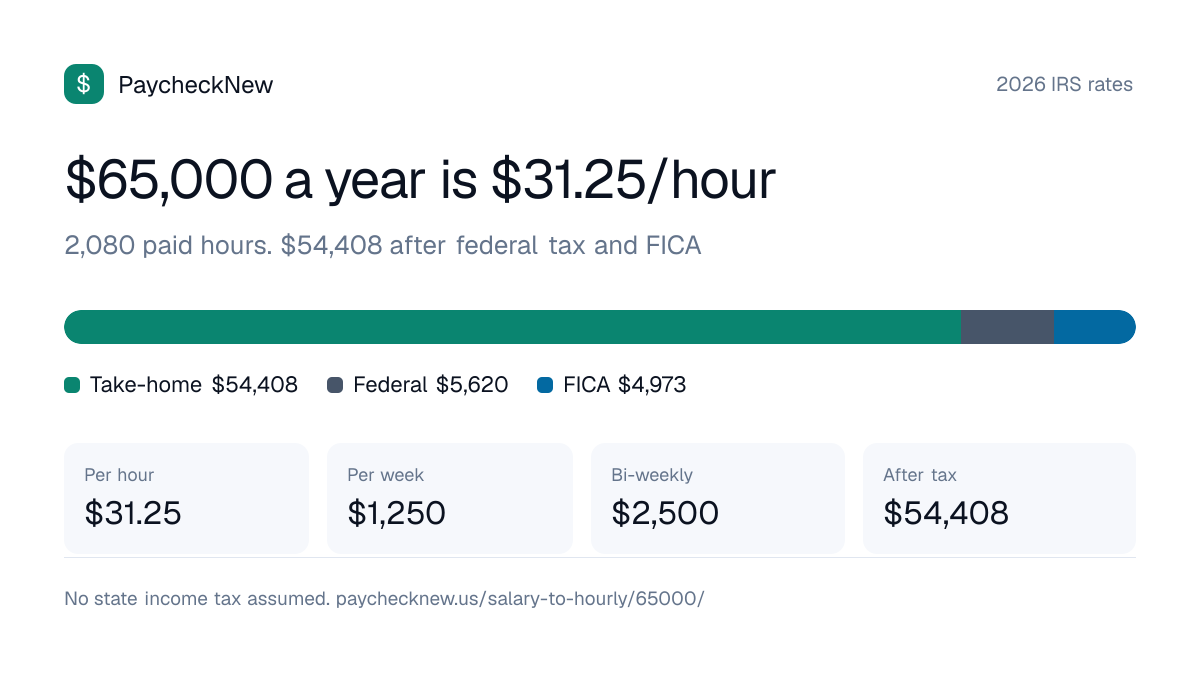
$65,000 a year is $31.25 an hour at 40 hours a week for 52 weeks (2,080 hours). That is $5,417 a month, $2,500 every two weeks and $1,250 a week before tax. After 2026 federal income tax and FICA, a single filer in a state with no income tax keeps about $26.16 an hour.
- Per hour, before tax
- $31.25
- Per week, before tax
- $1,250
- Bi-weekly, before tax
- $2,500
- Per month, before tax
- $5,417
Take-home pay per paycheck (26/yr)
$2,092.60
$54,408 a year from $65,000 gross, in Texas.
Take-home pay $2,092.60 per paycheck (26/yr), $54,408 a year, in Texas.
- Take-home pay 84%
- Federal income tax 9%
- Social Security (6.2%) 6%
- Medicare (1.45%) 1%
Which federal brackets your income fills
2026, singleOnly the part of your income inside each band is taxed at that band's rate. Your taxable income of $48,900 fills the bands below; the darker one is where your last dollar lands, which is your 12% marginal rate.
Breakdown
Texas, 2026| Item | Per paycheck | Per Year | % of gross |
|---|---|---|---|
| Gross pay | $2,500.00 | $65,000 | 100.0% |
| − Federal income tax8.6% | $216.15 | $5,620 | 8.6% |
| − Social Security (6.2%)6.2% | $155.00 | $4,030 | 6.2% |
| − Medicare (1.45%)1.5% | $36.25 | $943 | 1.5% |
| − Texas income tax0.0% | $0.00 | $0 | 0.0% |
| Take-home pay | $2,092.60 | $54,408 | 83.7% |
Your tax rates
- Effective rate 16.3%
- The share of your whole $65,000 that goes to tax. This is the one to quote when comparing offers.
- Marginal rate 12% federal
- What the next dollar you earn is taxed at. Always higher than the effective rate, and it is why a raise never leaves you worse off.
Estimate of annual tax liability spread evenly across pay periods, using 2026 federal rates, the standard deduction and no Texas income tax. Actual withholding depends on your W-4 and is squared up on your return.
65k a year hourly after taxes, by state (2026)
| State | Total tax | Net per year | Net per hour | Net bi-weekly |
|---|---|---|---|---|
| Texas | $10,593 | $54,408 | $26.16 | $2,092.60 |
| California | $13,500 | $51,500 | $24.76 | $1,980.77 |
| Tennessee | $10,593 | $54,408 | $26.16 | $2,092.60 |
| Colorado | $13,052 | $51,948 | $24.98 | $1,998.00 |
| Florida | $10,593 | $54,408 | $26.16 | $2,092.60 |
| Georgia | $13,343 | $51,657 | $24.84 | $1,986.80 |
| New Jersey | $13,250 | $51,750 | $24.88 | $1,990.38 |
| Virginia | $13,516 | $51,484 | $24.75 | $1,980.16 |
Single filer, standard deduction, no pre-tax deductions. Change the state above for your own figure.
How to use this calculator
- Step 1
Price an overtime hour against the salary
A salaried role at $65,000 pays the same whether you work 40 hours or 50. At 50 the real rate is $25.00 an hour rather than $31.25, a cut of $6.25 an hour that no payslip shows.
- Step 2
Choose your state for the after-tax rate
After federal tax and FICA alone the rate is $26.16 an hour. In Virginia it drops to $24.75, which is $2,923 a year of difference on the same salary.
- Step 3
Check which hours figure applies to you
$65,000 over 2,080 paid hours is $31.25 an hour, which is the figure payroll uses because it counts your holidays as paid. If you want the rate for hours actually worked, divide by about 1,880 instead: $34.57 an hour.
- Step 4
Separate the tax from the deductions
Of the $10,593 withheld on $65,000, $5,620 is federal income tax and $4,973 is FICA. Only the first responds to your W-4; the second is fixed by law and a 401(k) does not reduce it.
This salary sits just under the 12% bracket ceiling
Taxable income here is $48,900 after the $16,100 standard deduction, and the 12% band runs to $50,400 — only $1,500 above. A raise past that point is taxed at 22% on the excess ONLY, never on the whole salary, so crossing it cannot leave you worse off. It does mean the next $1,500 of any raise is worth more after tax than the amount that follows it.
$65,000 is exactly $2,500 a fortnight
Divide by 26 and it comes out clean, which makes this an unusually easy salary to budget on if you are paid biweekly — most are not, and the two three-cheque months that a 26-period year produces are what catch people out. It is also the figure the calculator on this page starts from before you change it, chosen because it sits just above the point where the 22% federal band begins to bite and therefore shows the bracket mechanics rather than hiding them.
Frequently asked questions
$65,000 a year is how much an hour?
$65,000 a year is $31.25 an hour, based on a 40-hour week and 52 paid weeks (2,080 hours). If you are not paid for holidays or vacation, divide by 2,000 hours instead, which gives $32.50 an hour.
How much is 65k a year per month?
$5,417 a month before tax. Per paycheck that is $2,500 bi-weekly, $2,708 semi-monthly or $1,250 a week.
What is 65k a year hourly after taxes?
About $26.16 an hour in a state with no income tax, once $5,620 of federal income tax and $4,973 of Social Security and Medicare come out. That is $54,408 a year, an effective tax rate of 16.3%. In California the same salary works out to about $24.76 an hour.
How much of $65,000 goes to Social Security and Medicare?
$4,973 a year: $4,030 in Social Security at 6.2% and $943 in Medicare at 1.45%. Your employer pays the same again, which never appears on your payslip but is part of what you cost. Neither is reduced by a traditional 401(k).
How much would a 401(k) change take-home on $65,000?
Deferring 10% — $6,500 — cuts federal tax from $5,620 to $4,840, but take-home falls from $54,408 to $48,688, because you moved your own pay into a retirement account. It reduces income tax, not Social Security or Medicare.
Read next
- $31 an hour is how much a year?The same conversion from the hourly side.
- Bi-weekly versus semi-monthly pay: why your check differs$65,000 is $2,500.00 bi-weekly or $2,708.33 semi-monthly.
- How a raise affects your paycheck, and the bracket mythWhat a raise from $65,000 actually adds after tax.
- Form W-4 explained: how it decides your withholdingSetting withholding so $65,000 neither owes nor over-withholds.
Hadi · Developer and maintainer
Federal tables checked against the IRS 2026 inflation adjustments on . State figures, where quoted, are each state's latest published schedule, 2025; federal figures are 2026.