$60,000 a year is how much an hour?
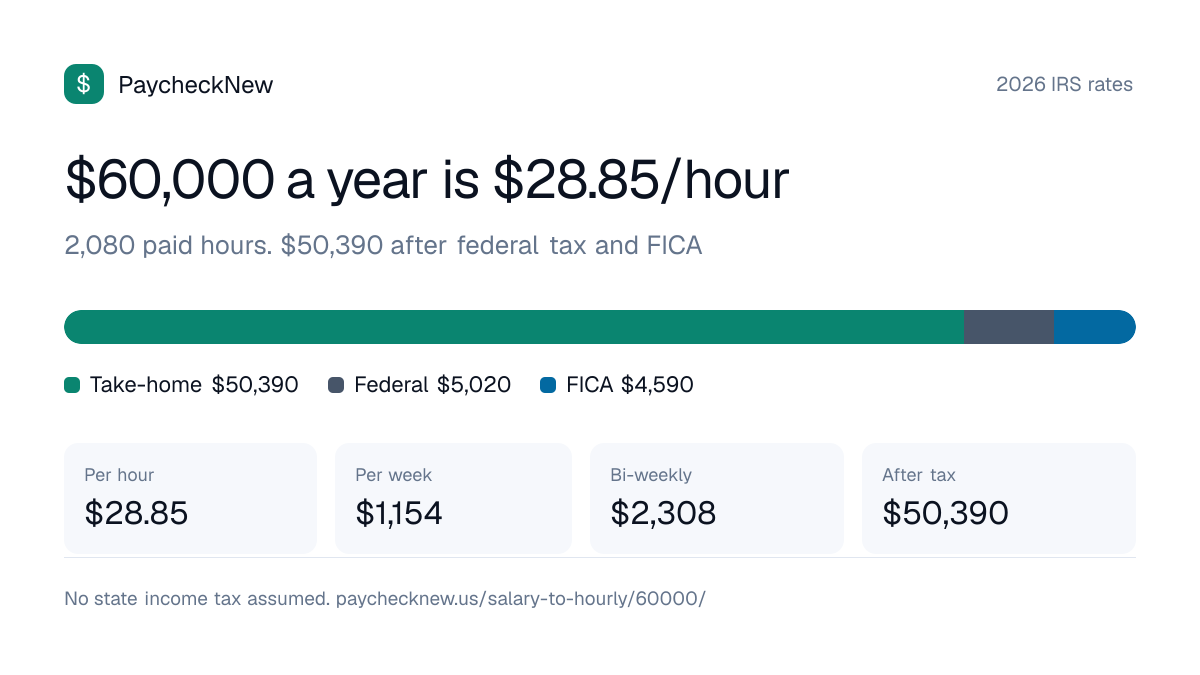
$60,000 a year is $28.85 an hour at 40 hours a week for 52 weeks (2,080 hours). That is $5,000 a month, $2,308 every two weeks and $1,154 a week before tax. After 2026 federal income tax and FICA, a single filer in a state with no income tax keeps about $24.23 an hour.
- Per hour, before tax
- $28.85
- Per week, before tax
- $1,154
- Bi-weekly, before tax
- $2,308
- Per month, before tax
- $5,000
Take-home pay per paycheck (26/yr)
$1,938.08
$50,390 a year from $60,000 gross, in Texas.
Take-home pay $1,938.08 per paycheck (26/yr), $50,390 a year, in Texas.
- Take-home pay 84%
- Federal income tax 8%
- Social Security (6.2%) 6%
- Medicare (1.45%) 1%
Which federal brackets your income fills
2026, singleOnly the part of your income inside each band is taxed at that band's rate. Your taxable income of $43,900 fills the bands below; the darker one is where your last dollar lands, which is your 12% marginal rate.
Breakdown
Texas, 2026| Item | Per paycheck | Per Year | % of gross |
|---|---|---|---|
| Gross pay | $2,307.69 | $60,000 | 100.0% |
| − Federal income tax8.4% | $193.08 | $5,020 | 8.4% |
| − Social Security (6.2%)6.2% | $143.08 | $3,720 | 6.2% |
| − Medicare (1.45%)1.5% | $33.46 | $870 | 1.5% |
| − Texas income tax0.0% | $0.00 | $0 | 0.0% |
| Take-home pay | $1,938.08 | $50,390 | 84.0% |
Your tax rates
- Effective rate 16.0%
- The share of your whole $60,000 that goes to tax. This is the one to quote when comparing offers.
- Marginal rate 12% federal
- What the next dollar you earn is taxed at. Always higher than the effective rate, and it is why a raise never leaves you worse off.
Estimate of annual tax liability spread evenly across pay periods, using 2026 federal rates, the standard deduction and no Texas income tax. Actual withholding depends on your W-4 and is squared up on your return.
60k a year hourly after taxes, by state (2026)
| State | Total tax | Net per year | Net per hour | Net bi-weekly |
|---|---|---|---|---|
| Texas | $9,610 | $50,390 | $24.23 | $1,938.08 |
| California | $12,123 | $47,877 | $23.02 | $1,841.44 |
| Arizona | $10,716 | $49,284 | $23.69 | $1,895.53 |
| Michigan | $11,914 | $48,087 | $23.12 | $1,849.48 |
| Pennsylvania | $11,452 | $48,548 | $23.34 | $1,867.23 |
| New York | $12,538 | $47,462 | $22.82 | $1,825.47 |
| Illinois | $12,439 | $47,561 | $22.87 | $1,829.27 |
| South Carolina | $11,623 | $48,377 | $23.26 | $1,860.65 |
Single filer, standard deduction, no pre-tax deductions. Change the state above for your own figure.
How to use this calculator
- Step 1
Sanity-check it against your payslip
Your net per period should be about $1,938 bi-weekly or $4,199 monthly before any benefit deductions. If yours is materially lower, look for a health premium, a 401(k) percentage or a state with its own payroll levy.
- Step 2
Choose your state for the after-tax rate
After federal tax and FICA alone the rate is $24.23 an hour. In South Carolina it drops to $23.26, which is $2,013 a year of difference on the same salary.
- Step 3
Separate the tax from the deductions
Of the $9,610 withheld on $60,000, $5,020 is federal income tax and $4,590 is FICA. Only the first responds to your W-4; the second is fixed by law and a 401(k) does not reduce it.
- Step 4
Check which hours figure applies to you
$60,000 over 2,080 paid hours is $28.85 an hour, which is the figure payroll uses because it counts your holidays as paid. If you want the rate for hours actually worked, divide by about 1,880 instead: $31.91 an hour.
This salary is taxed entirely in the two lowest bands
After the $16,100 standard deduction, taxable income is $43,900, which never reaches the 22% band. Federal income tax comes to $5,020 — an effective federal rate of 8.4% on the full salary. FICA is the larger deduction at this level: $4,590 against $5,020 of income tax, which surprises most people who assume income tax is the main charge.
Why this site measures everything against $60,000
Exactly $5,000 a month, which is the reason it became the benchmark here: every one of the 51 state pages is worked at this salary, so the figures on them are directly comparable to each other rather than to a number chosen per page. If you are comparing states, this is the salary to compare them at — and the spread between the best and worst jurisdiction at $60,000 is the cleanest measure on the site of what a state income tax is actually worth.
Frequently asked questions
$60,000 a year is how much an hour?
$60,000 a year is $28.85 an hour, based on a 40-hour week and 52 paid weeks (2,080 hours). If you are not paid for holidays or vacation, divide by 2,000 hours instead, which gives $30.00 an hour.
How much is 60k a year per month?
$5,000 a month before tax. Per paycheck that is $2,308 bi-weekly, $2,500 semi-monthly or $1,154 a week.
What is 60k a year hourly after taxes?
About $24.23 an hour in a state with no income tax, once $5,020 of federal income tax and $4,590 of Social Security and Medicare come out. That is $50,390 a year, an effective tax rate of 16.0%. In California the same salary works out to about $23.02 an hour.
Is $60,000 a good salary?
It depends almost entirely on where you live, and the tax is the smaller half of that. The same $60,000 keeps $50,390 in Texas and $47,877 in California, a gap of $2,513, but housing costs between two cities routinely differ by several times that. Compare take-home first, then rent.
How much does one child change the tax on $60,000?
The child tax credit is worth $2,200 per qualifying child under 17 and comes off the tax itself, not the income. On $60,000 it takes federal tax from $5,020 to $2,820 and lifts take-home to $52,590.
Read next
- $29 an hour is how much a year?The same conversion from the hourly side.
- Bi-weekly versus semi-monthly pay: why your check differs$60,000 is $2,307.69 bi-weekly or $2,500.00 semi-monthly.
- How a raise affects your paycheck, and the bracket mythWhat a raise from $60,000 actually adds after tax.
- Form W-4 explained: how it decides your withholdingSetting withholding so $60,000 neither owes nor over-withholds.
Hadi · Developer and maintainer
Federal tables checked against the IRS 2026 inflation adjustments on . State figures, where quoted, are each state's latest published schedule, 2025; federal figures are 2026.