How a raise affects your paycheck, and the bracket myth
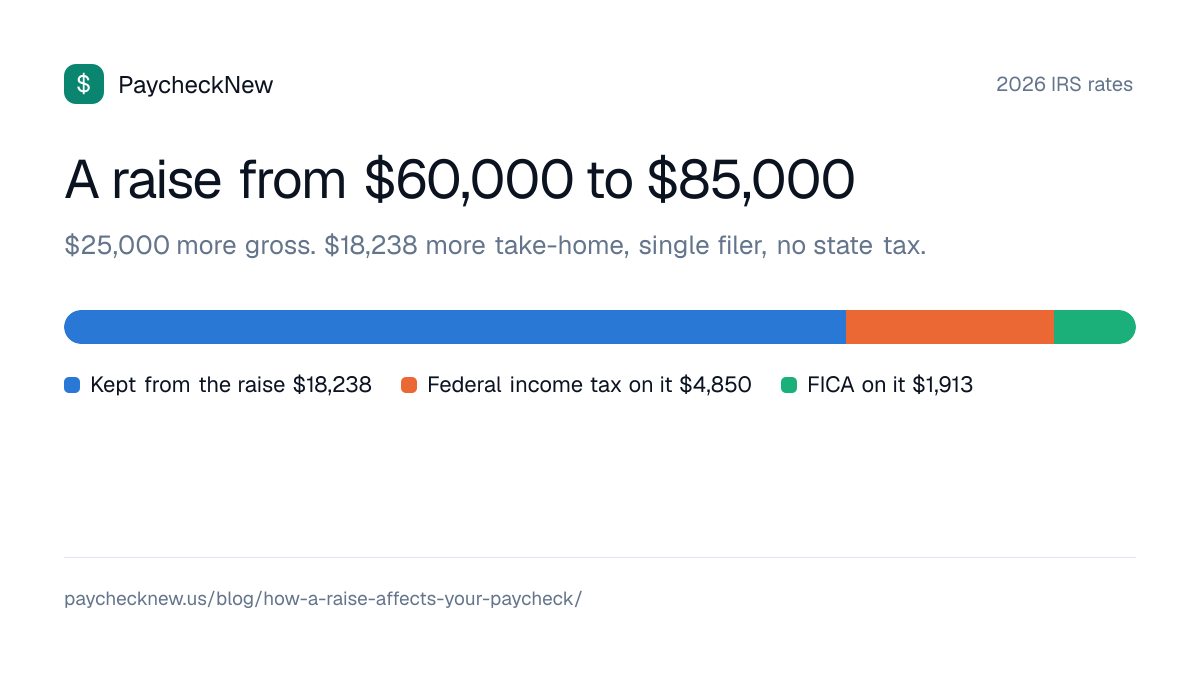
A raise from $60,000 to $85,000 adds $25,000 of gross. It adds $18,238 of take-home for a single filer in a no-tax state. That is 73% of the raise, which is a long way from the feeling that a raise mostly goes to tax.
Marginal means the next dollar, not every dollar
Federal brackets are steps. The first $12,400 of taxable income is taxed at 10%, the next slice at 12%, the next at 22%, and so on. Crossing into the 22% bracket means only the dollars above the line pay 22%. The dollars below are untouched. Nobody has ever taken home less because of a raise that crossed a federal bracket.
The raise, line by line
From $60,000 to $85,000: federal income tax rises from $5,020 to $9,870, Social Security and Medicare from $4,590 to $6,503. Total tax on the extra $25,000 is $6,763, an effective 27% on the raise itself.
Why the first raised check can disappoint
Withholding on the new salary starts immediately, and if the raise is backdated the catch-up lands in one check that is withheld as if it were a permanent higher salary. The following checks settle. Compare the second check after a raise, not the first.
The one place a raise can cost you
Not the tax brackets. Income-tested benefits and credits phase out with income, and a raise can reduce or end them: a premium subsidy for marketplace health insurance, the earned income credit, income-driven student loan payments. Those are real cliffs, and they are a reason to run the whole household picture rather than just the paycheck.
Run your own numbers
Every figure above came from the paycheck calculator with 2026 rates.
Frequently asked questions
Can a raise put me in a higher tax bracket and lower my take-home?
No. Only the income above the bracket line is taxed at the higher rate, so take-home always rises with gross. The idea that a raise can cost money comes from confusing marginal rate with effective rate.
What is the difference between marginal and effective rate?
The marginal rate is what the next dollar is taxed at. The effective rate is total tax divided by total income, and it is always lower. On a raise, the extra income is taxed at the marginal rate, which is why the percentage kept on a raise is a little lower than the percentage kept overall.
Should I ask for a raise that keeps me under a bracket?
No. There is no amount of raise that leaves you worse off through federal brackets. Ask for the number the work is worth.
Read next
- How bonuses are taxed, and why the check looks so smallSupplemental wages are withheld at a flat 22% federal rate, which is often more than your normal rate, but the bonus is taxed as ordinary income when you file.
- Overtime pay: how time and a half is taxedOvertime is taxed as ordinary wages, but a big check can be withheld at a higher rate.
- Form W-4 explained: how it decides your withholdingWhat each step of the W-4 does to your paycheck, why the form has no allowances any more, and how to set it so you neither owe nor over-withhold.
- Every paycheck deduction, in orderThe parent page for all of these.
Hadi · Developer and maintainer
Federal tables checked against the IRS 2026 inflation adjustments on . State figures, where quoted, are each state's latest published schedule, 2025; federal figures are 2026.