Overtime pay: how time and a half is taxed
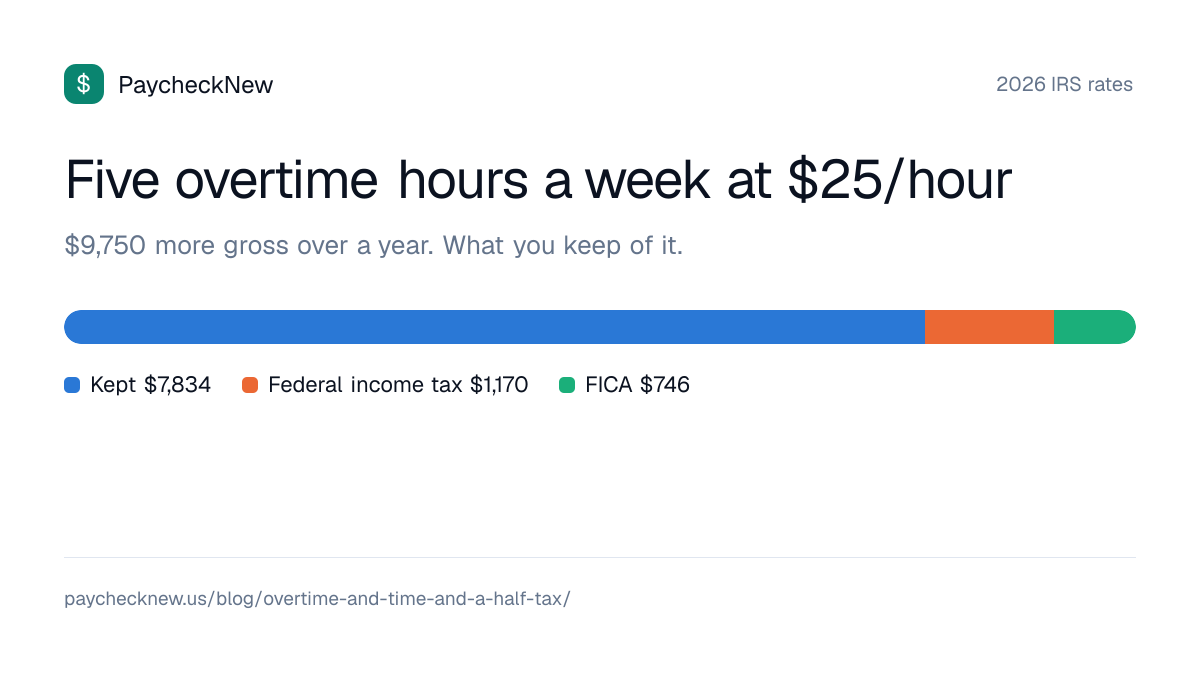
Time and a half on $25 an hour is $37.50. Five overtime hours a week for a year is $9,750 on top of a $52,000 salary. The tax on it is the same as on any other wage, but the withholding on the check it arrives in may not look that way.
Who gets it
Federal law requires 1.5 times the regular rate for hours over 40 in a workweek for non-exempt employees. Salaried does not mean exempt; exemption depends on duties and a salary threshold, and a salaried worker below it is owed overtime. Some states add daily overtime, California after eight hours in a day.
It is taxed as ordinary income
Overtime is added to your wages and taxed at your marginal rate, not a special one. On $25 an hour, the extra $9,750 raises federal income tax from $4,060 to $5,230 and take-home from $43,962 to $51,796. You keep $7,834 of the $9,750, about 80%.
Why the overtime check looks over-taxed
Withholding tables annualise each check. A check with 20 hours of overtime looks, to the formula, like a much higher salary, so a higher rate is applied to that check. The next normal check withholds normally, and the year's total reconciles on your return. The money was withheld, not taken.
You never lose money by earning more
Only the dollars above a bracket threshold are taxed at the higher rate. Crossing from the 12% bracket into the 22% bracket does not re-tax the income below the line. Turning down overtime to avoid a bracket is turning down money.
Run your own numbers
Every figure above came from the paycheck calculator with 2026 rates.
Frequently asked questions
Is overtime taxed at a higher rate than regular pay?
No. It is ordinary income at your normal marginal rate. The check it arrives in may be withheld at a higher rate because withholding tables annualise each check, and the difference comes back at filing time.
Does overtime count for Social Security?
Yes, it is wages like any other, subject to 6.2% Social Security up to $184,500 and 1.45% Medicare with no ceiling.
Is double time taxed differently?
No. Double time, shift differentials and holiday premiums are all ordinary wages. The rate you were paid for the hour does not change how the income is taxed.
Read next
- Salary versus hourly: which actually pays moreA $30-an-hour job and a $62,400 salary are the same gross on paper.
- How a raise affects your paycheck, and the bracket mythWhat a raise actually adds to take-home, and why crossing a bracket never costs you money.
- How bonuses are taxed, and why the check looks so smallSupplemental wages are withheld at a flat 22% federal rate, which is often more than your normal rate, but the bonus is taxed as ordinary income when you file.
- Every paycheck deduction, in orderThe parent page for all of these.
Hadi · Developer and maintainer
Federal tables checked against the IRS 2026 inflation adjustments on . State figures, where quoted, are each state's latest published schedule, 2025; federal figures are 2026.