Minnesota paycheck: how much tax is taken out? (2026)
$11,927 of a $58,000 salary goes to tax in Minnesota in 2026, $2,710 of it to the state. Below is every line on that salary and on $42,000, $72,000, $72,000, $102,000, $150,000, computed from the same tables the calculator uses.

The short answer for Minnesota
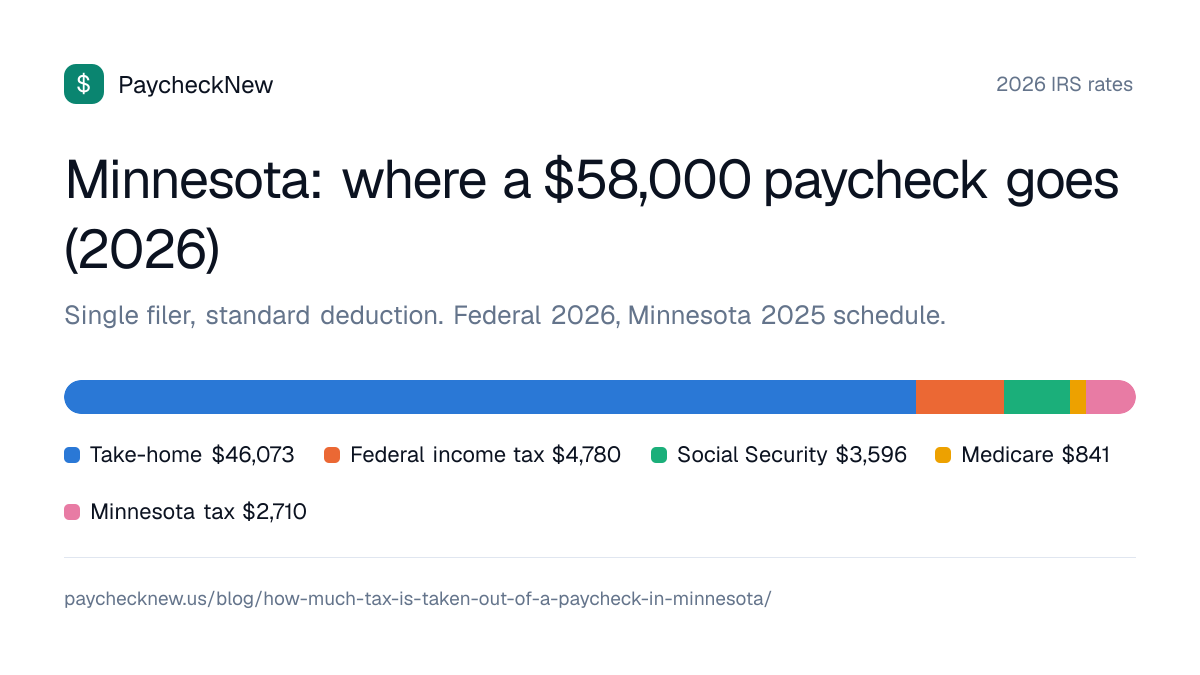
A single filer earning $58,000 in Minnesota has $11,927 taken out over the 2026 tax year, 20.6% of gross: $4,780 federal income tax, $4,437 Social Security and Medicare, and $2,710 to Minnesota. Take-home is $46,073.
That is $886.01 a week, $1,772.03 every two weeks, $1,919.69 twice a month or $3,839.39 a month. Taxable income of $41,900 after the $16,100 standard deduction puts the last dollar in the 12.0% federal bracket. On a $60,000 salary Minnesota ranks 46 of 51 for take-home, $842 below the national median of $48,377.
The Minnesota state line
Minnesota uses 4 brackets, from 5.35% to 9.85%: 5.35% on the first $32,570, 6.80% up to $106,990, 7.85% up to $198,630, 9.85% above that. A single filer on $58,000 pays $2,455 to the state, with 6.80% on the next dollar. Paid Leave premiums start 1 January 2026.
On top of income tax, Minnesota employees pay into MN Paid Leave at 0.44% on wages up to $184,500: $255 a year on $58,000, on its own line.
At other salaries in Minnesota
On $42,000, $7,705 comes out (18.3%) and $34,295 stays, $1,319.04 every two weeks.
On $72,000, $16,242 comes out (22.6%) and $55,758 stays, $2,144.54 every two weeks.
On $72,000, $16,242 comes out (22.6%) and $55,758 stays, $2,144.54 every two weeks.
On $102,000, $27,309 comes out (26.8%) and $74,691 stays, $2,872.73 every two weeks.
On $150,000, $45,875 comes out (30.6%) and $104,125 stays, $4,004.82 every two weeks.
Married filing jointly on $72,000 keeps $59,643 against $55,758 for a single filer, $3,885 more, because the federal standard deduction doubles to $32,200 and Minnesota's to $29,900.
How Minnesota compares
On $60,000, Alaska keeps the most at $50,390, $2,855 more than Minnesota. The nearest state above Minnesota is Connecticut at $47,540. The nearest below is New York at $47,462.
What moves the Minnesota number
A traditional 401(k) at 6% on $72,000 sends $4,320 into the plan and cuts tax by $1,263, so take-home falls by only $3,057. Health premiums of $200 a month under a section 125 plan cut $885 of tax on the same salary, because they come out before FICA as well as income tax.
Run your own numbers
Every figure above came from the Minnesota paycheck calculator with 2026 rates.
Frequently asked questions
How much is taken out of a $1,000 paycheck in Minnesota?
For a single filer paid $1,000 a week ($52,000 a year), about $198.34 comes out of each $1,000: $78.08 federal income tax, $76.50 FICA and $43.77 Minnesota tax, leaving $801.66.
How much tax is taken out of a $42,000 salary in Minnesota?
$7,705 a year, 18.3% of gross, leaving $34,295 or $1,319.04 every two weeks for a single filer taking the standard deduction.
What percentage of my paycheck goes to taxes in Minnesota?
Between 18.3% on $42,000 and 30.6% on $150,000 for a single filer in Minnesota. The share rises with income because federal tax is progressive and so is Minnesota's.
Does Minnesota have state income tax?
Yes, 4 brackets from 5.35% to 9.85%, on the 2025 schedule, the latest published.
Read next
- Minnesota paycheck calculatorRun your own salary through the Minnesota tables.
- Connecticut paycheck: how much tax is taken out? (2026)$11,947 on a $58,000 salary in Connecticut, 20.6% of gross, leaving $46,053 a year or $1,771.27 every two weeks.
- New York paycheck: how much tax is taken out? (2026)$14,375 on a $67,000 salary in New York, 21.5% of gross, leaving $52,625 a year or $2,024.02 every two weeks.
- Moving to another state: what happens to your paycheckThe same salary differs by thousands a year between states.
- Every paycheck deduction, in orderThe parent page for all of these.
Hadi · Developer and maintainer
Federal tables checked against the IRS 2026 inflation adjustments on . State figures, where quoted, are each state's latest published schedule, 2025; federal figures are 2026.