Traditional or Roth 401(k): what changes on your paycheck
Both put the same money into the same plan. The difference is when the tax is paid. A traditional contribution skips tax now and pays it in retirement; a Roth pays tax now and skips it later. On the paycheck, that shows up as two different net amounts for the same 6%.
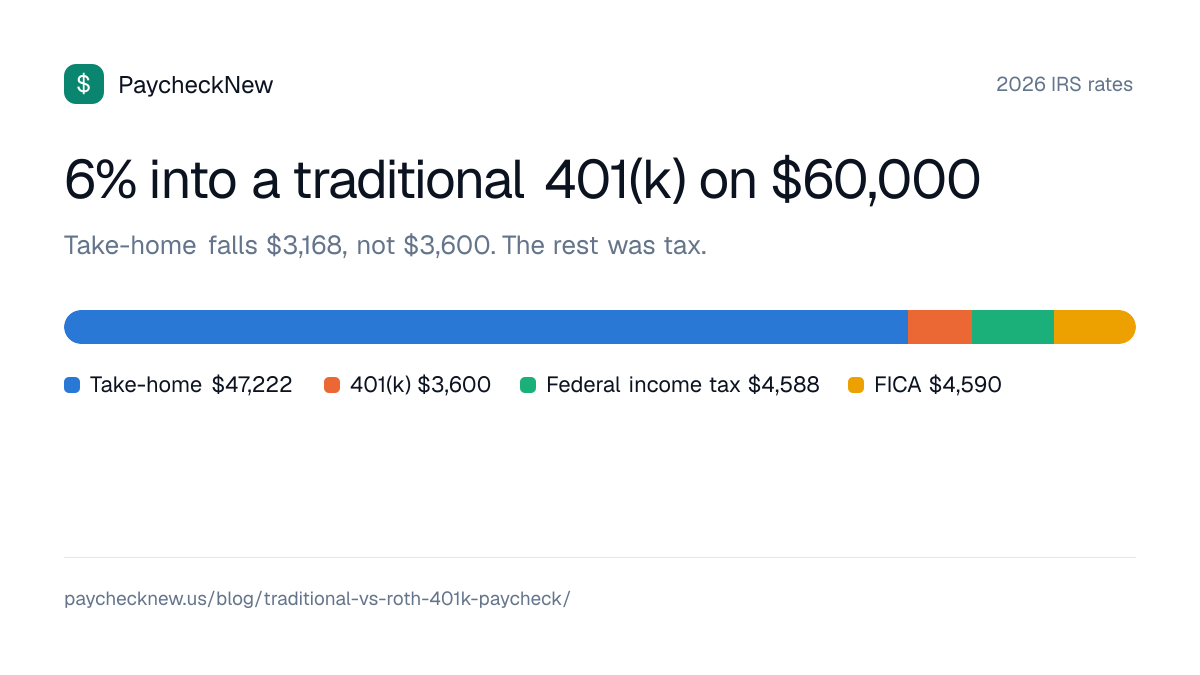
Traditional: the paycheck drops by less than you put in
Contributing 6% of $60,000 moves $3,600 into the plan. Federal income tax falls from $5,020 to $4,588, so take-home drops by $3,168, not the full $3,600. The $432 difference is tax you would have paid.
Social Security and Medicare do not change. A traditional 401(k) reduces income tax only, which is why the saving is smaller than people expect.
Roth: the paycheck drops by the full amount
The same 6% into a Roth is taken after tax, so take-home falls by the whole $3,600. Nothing changes on the federal line. What you gain is that the $3,600 and everything it earns comes out tax-free in retirement.
Which is better depends on one question
Will your tax rate in retirement be higher or lower than it is now? Lower, and traditional wins, because you skip a high rate today and pay a low one later. Higher, and Roth wins. Nobody knows their retirement rate, which is why splitting between the two is a common answer.
There is a practical tilt for early-career earners in the 12% bracket: paying 12% now to never pay tax on the growth is cheap. For someone in the 24% bracket, the immediate deduction is worth more.
The employer match is always traditional
Whichever you choose, matching contributions go into the traditional side of the plan and are taxed on withdrawal. A Roth 401(k) is therefore never entirely tax-free at the account level.
Run your own numbers
Every figure above came from the paycheck calculator with 2026 rates.
Frequently asked questions
Does a Roth 401(k) reduce my taxable income?
No. Roth contributions are made from pay that has already been taxed, so your federal taxable wages are unchanged. Only traditional contributions reduce the taxable figure on your W-2.
Can I have both?
Most plans that offer a Roth option let you split contributions in any proportion. The combined employee limit applies across both, not to each separately.
Does either one reduce Social Security tax?
No. Neither type of 401(k) reduces Social Security or Medicare wages. Only Section 125 benefits such as health premiums and FSA contributions do that.
Read next
- How bonuses are taxed, and why the check looks so smallSupplemental wages are withheld at a flat 22% federal rate, which is often more than your normal rate, but the bonus is taxed as ordinary income when you file.
- How to read a US pay stub, line by lineWhat each line on a pay stub means, in the order payroll applies it, with a $60,000 example showing how gross becomes net in 2026.
- How a raise affects your paycheck, and the bracket mythWhat a raise actually adds to take-home, and why crossing a bracket never costs you money.
- Every paycheck deduction, in orderThe parent page for all of these.
Hadi · Developer and maintainer
Federal tables checked against the IRS 2026 inflation adjustments on . State figures, where quoted, are each state's latest published schedule, 2025; federal figures are 2026.